
New York State backflow compliance
The DOH-1013 form, explained by people who actually fill it out.
The DOH-1013 is the New York State Department of Health form used to report annual backflow prevention device tests. This page covers what's on it, how to complete it without getting rejected, and what happens after you submit it. Written for testers, property owners, and district staff.
What is the DOH-1013 form?
The DOH-1013 is a one-page form issued by the New York State Department of Health, Bureau of Public Water Supply Protection. Its full name is Report on Test and Maintenance of Backflow Prevention Device. Every backflow prevention device installed in New York must be tested annually by a NYS-certified tester, and the results of that test must be recorded on the DOH-1013 and submitted within 30 days to two places: the local water supplier (your water district), and the county or local health department.
If you own a property with a backflow device — typically required if you have an irrigation system, fire suppression line, boiler, or commercial plumbing — your tester fills out this form on your behalf each year. As the property owner, your only obligation is to make sure the test gets done annually and that the form gets to your water district.
The form has been in use since 1991 and was last revised in 1993. The instructions document was updated in 2019. Despite the age, the form itself is still the legally required reporting document — there is no "newer" or "v2" form.
Why does this form exist? New York State Sanitary Code §10 NYCRR 5-1.31 requires water suppliers to maintain a service-protection (containment) program, which includes tracking annual tests on every backflow device in their service area. The DOH-1013 is the standardized record that lets the water district prove to the State that they're meeting that obligation.
What happens if you don't submit it? Most water districts in Nassau County will issue a non-compliance notice after 30 days overdue. After 90 days, many districts impose civil penalties — Jericho Water District, for example, levies $250 per untested device on non-residential accounts under the Nassau County Civil Divisions Act. Some districts can shut off water service for chronic non-compliance.
Every field on the DOH-1013, explained.
This walkthrough goes top to bottom. If you're a tester, this is the section you came for. If you're a property owner, you can skip it — your tester handles all of this.
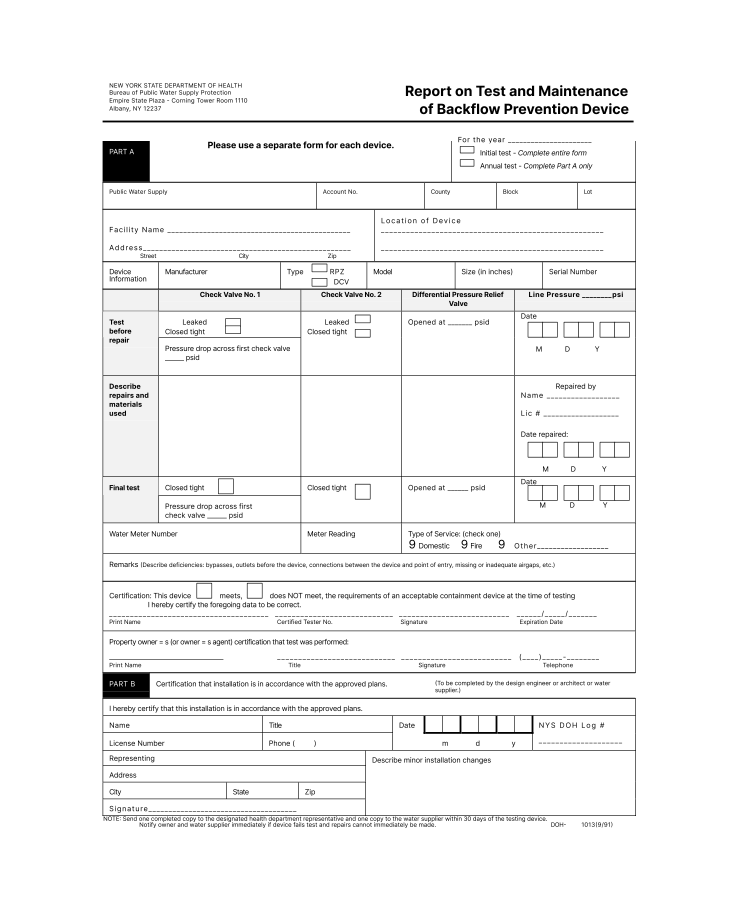
The header block
Test year and test type:
At the top of the form, you indicate (1) the calendar year of the test, and (2) whether this is an Initial test (newly installed device, never before tested) or an Annual test (recurring yearly test on an existing device). This matters because Initial tests require both Part A and Part B to be completed; annual tests require only Part A. If you accidentally check "Initial" on an annual test, the form will sit incomplete in the district queue until they email you back to clarify.
Public Water Supply, Account No., County, Block, Lot:
- Public Water Supply — the name of the water district that serves this address (e.g., "Plainview Water District," "Jericho Water District"). If you're not sure, the property owner's water bill has it.
- Account No. — the customer's account number with the water district. Without this, many districts can't match the form to a property in their billing system. This is a top-3 rejection reason.
- County — almost always "Nassau" or "Suffolk" for Long Island work.
- Block / Lot — only required for NYC metropolitan area tests. For Nassau and Suffolk County, leave blank or use the section/block/lot from the property's tax map if known.
Facility Name and Address:
The legal name of the facility being tested (e.g., "Smith Residence," "Walgreens Store #4521") and the full street address. Use the address as the water district has it on file, not the postal address. These can differ — for example, a building's water service might be listed under "1515 Old Country Rd" while the postal address is "1515-A Old Country Road, Suite 4." Mismatches trigger rejections.
Location of Device:
A specific in-building or on-site description of where the device is physically installed: "meter pit, NW corner of property," "basement utility room behind boiler," "exterior mount, south side, behind shrubs." Vague descriptions like "outside" or "in basement" are a common rejection reason — districts may need to physically inspect, and they need to find the device.
The device information block
Manufacturer, Type (RPZ / DCV), Model, Size, Serial Number:
The form has only two device-type checkboxes: RPZ (Reduced Pressure Zone) and DCV (Double Check Valve Assembly). The DOH-1013 does not cover Pressure Vacuum Breakers (PVB) or Spill-Resistant Vacuum Breakers (SVB) — those are tested under a separate procedure and use different reporting forms. If your device is a PVB or SVB, this is the wrong form.
For detector assemblies (DCDA, DCDA-II, RPDA, RPDA-II), check the closest base type (DCV for DCDA, RPZ for RPDA) and use the Remarks section to specify it's a detector assembly. The form predates detector assemblies as a common installation type.
- Manufacturer — Watts, Febco, Wilkins, Apollo, Conbraco, Ames, etc.
- Model — exact model number from the device tag (e.g., "Watts 909," "Febco 825YA," "Wilkins 975XL").
- Size — pipe size in inches: 3/4", 1", 1-1/4", 1-1/2", 2", 2-1/2", 3", 4", 6", 8", 10".
- Serial Number — stamped on the device body or label. Missing or incorrect serial numbers are the #1 rejection reason cited by Nassau County districts. If the serial number is illegible (corroded, painted over), photograph the device and note "S/N illegible — see attached photo" in Remarks.
The test results block ("Test before repair")
This is where the actual test data goes. The form has three columns:
- Check Valve No. 1 — closed tight or leaked + pressure drop in psid
- Check Valve No. 2 — closed tight or leaked + pressure drop in psid
- Differential Pressure Relief Valve — opened at __ psid (RPZ devices only)
Plus a single Line Pressure field (in psi) and a Date field for the test date.
For each check valve, you record:
- Whether it closed tight (held against backpressure — passing condition) or leaked (failed to hold — failing condition)
- The pressure drop across the valve, in pounds per square inch differential (psid)
For the relief valve (RPZ only), you record the pressure differential at which the relief valve opened.
For pass/fail thresholds by device type, see the Pass/Fail Criteria section below.
The repair section
If any reading in the "Test before repair" section failed, you record:
- Describe repairs and materials used — free-text description (e.g., "Replaced CV1 spring and rubber seat. Cleaned poppet. Replaced relief valve diaphragm.")
- Repaired by — name and license number of the repairer (which can be you, if you're licensed to repair as well as test)
- Date repaired — date the repair was completed
The "Final test" section
Only completed if repairs were made. Record the post-repair test results in the same format as the initial test row. The final-test readings are what determine the overall pass/fail. The initial-test readings are preserved for audit trail purposes (they document what was wrong with the device before repair).
A common confusion: if the device passes on the initial test (no repairs needed), leave the Final test row blank. Don't repeat the initial readings — that signals to the reviewer that you re-tested unnecessarily and may trigger questions.
The water service block
- Water Meter Number — exact meter number, copied from the meter face. Should match the district's records. Mismatches are a common rejection reason — the district uses the meter number to match the form to a service account.
- Meter Reading — the current reading at the time of test. Some districts cross-reference this against their billing records; significant discrepancies (more than a few hundred gallons off) can flag the form for review.
- Type of Service — check one: Domestic, Fire, or Other. If "Other," describe (e.g., "irrigation," "boiler feed," "process water").
Remarks
Free-text section for any deficiencies you observed: bypasses around the device, outlets installed before (upstream of) the device, missing or inadequate air gaps, connections between the device and point of entry, missing shutoff valves, etc. An empty Remarks section is fine — it means you observed no deficiencies. Don't write "N/A" or "none" unless you mean it; some district reviewers interpret blank as unchecked and will ask.
Tester certification
This is where you, the certified tester, certify the data and check whether the device meets or does not meet requirements. Five fields, all required:
- Print Name — your full name
- Certified Tester No. — your NYS DOH certification number (e.g., "NY-12345")
- Signature — wet ink or accepted electronic signature
- Expiration Date — the expiration date of your tester certification. This is a top-5 rejection reason: testers fill in the expiration date of the test kit calibration here by mistake. The form asks for your certification's expiration date.
If your certification has expired on the test date, the form is invalid regardless of how cleanly you completed it. NYS tester certifications are valid for three years from issuance.
Property owner certification
The property owner (or owner's authorized agent — typically the building manager or facility manager) must sign that the test was performed:
- Print Name — owner's or agent's full name
- Title — owner, manager, agent, etc.
- Signature — wet ink or accepted electronic signature
- Telephone — contact number
Submission note
The form's footer states: "Send one completed copy to the designated health department representative and one copy to the water supplier within 30 days of the testing device. Notify owner and water supplier immediately if device fails test and repairs cannot immediately be made."
This is the legal submission requirement embedded in the form itself. The Submission Requirements section below covers the operational implications.
Part A vs Part B — when do you need both?
The DOH-1013 has two parts:
| Part | Who fills it out | When required |
|---|---|---|
| Part A | NYS-certified backflow tester | Every annual test AND every initial test |
| Part B | Design engineer, registered architect, OR water supplier | Only on initial tests (newly installed devices) |
For an annual test on a device that's been in service for a year or more: only Part A. Leave Part B blank.
For an initial test on a brand-new installation: both Part A and Part B. Part B is the design professional certifying that the device was installed in accordance with the approved plans. The plans were originally submitted to NYSDOH via Form DOH-347 (Application for Approval of Backflow Prevention Devices) before installation began.
The NYS DOH Log # field on Part B refers to the log number assigned when the original DOH-347 was approved. The design professional or the water supplier can usually look this up if you don't have it.
A common scenario: A device fails annually and is replaced rather than repaired. The replacement device, even if it's the same make/model in the same location, is technically a new installation and triggers an initial test (Part A + Part B + a fresh DOH-347 if it's a different model or location). Many testers don't know this and submit only Part A, and the form is rejected.
What counts as a pass? The pressure thresholds, by device type.
The DOH-1013 form lists "leaked" or "closed tight" but doesn't print the numeric pass thresholds. Here they are:
| Device family | Component | Pass criteria |
|---|---|---|
| DC family (DCV, DCDA, DCDA-II) | Check Valve #1 (CV1) | Closed AND held ≥ 1.0 psid |
| DC family | Check Valve #2 (CV2) | Closed AND held ≥ 1.0 psid |
| RP family (RPZ, RPDA, RPDA-II) | Check Valve #1 (CV1) | Closed AND held ≥ 5.0 psid |
| RP family | Check Valve #2 (CV2) | Closed AND held ≥ 1.0 psid |
| RP family | Differential Pressure Relief Valve | Opened at ≥ 2.0 psid |
A check valve fails if it leaked (didn't hold pressure at all) OR if it held but the pressure drop was below the threshold for the device family.
Important: The DOH-1013 form's instructions explicitly state: "For RPZ devices, the pressure drop across the check valve must be at least 5.0 psid" and "Opening of RPZ differential pressure relief valve — must be at least 2.0 psid or device must be failed and/or repaired." These thresholds are not optional and are the same statewide.
For detector assemblies (DCDA, RPDA): Both the main assembly and the bypass assembly must pass for the overall device to pass. A passing main with a failing bypass is a failing overall device.
For PVB and SVB devices: Different procedures, different forms. Not covered by DOH-1013. PVBs are typically tested with a single-gauge procedure that records the pressure at which the air inlet valve opens; SVBs use a separate static-and-dynamic procedure per ASSE 1056.
What happens when a device fails the initial test?
If the device fails any component on the initial test, three things happen on the same form:
- The initial (failing) readings are preserved. Don't erase or whiteout. The failing readings document the device's pre-repair condition for audit trail.
- The repair is documented. In the "Describe repairs and materials used" section, write what was repaired (e.g., "Replaced CV1 spring kit, replaced relief valve seat, cleaned poppet"). Record the repairer's name and license number. The repairer can be the same person as the tester if licensed.
- The device is re-tested. The post-repair readings go into the "Final test" row. The final-test readings determine the overall pass/fail of the device.
If the device passes after repair, the form is submitted with both rows filled (initial showing failure, final showing pass). If the device fails again after repair, the form is submitted with both rows showing failure, and the form is marked "does NOT meet requirements." The owner and water supplier must be notified immediately per the form's submission notice.
A few common edge cases:
- The device passes the initial test. Leave the Final test row entirely blank. Don't fill in the same readings — that's a common error that creates ambiguity for the reviewer.
- A repair is needed but you don't have parts on-site. Submit the form marked "does NOT meet requirements," notify the owner and water supplier as required by the form, and schedule the repair + retest. The retest will require a new DOH-1013, not a continuation of the failing one.
- You replaced the entire device. As discussed in the Part A vs Part B section, this is a new installation. New DOH-1013, both Part A and Part B, possibly a new DOH-347 depending on whether the model changed.
The 9 most common reasons a DOH-1013 gets rejected.
Compiled from publicly published rejection criteria across Nassau County water districts (Albertson, Bayville, Plainview, Port Washington, South Farmingdale) plus our conversations with district staff.
1. Missing or incorrect device serial number
Why it matters: The serial number uniquely identifies the device in the district's records. A wrong or missing serial number means the district can't confirm which device was actually tested.
How to avoid it: Read the serial number directly off the device tag — don't rely on the property owner's records. If the tag is corroded or illegible, photograph the device and write "S/N illegible — see attached photo" in Remarks.
2. Missing property owner signature
Why it matters: The form requires owner certification that the test was performed. Without it, multiple Nassau County districts (Bayville is on record) will reject regardless of how clean the test data is.
How to avoid it: Confirm the owner or an authorized agent is on-site at test time. If they aren't, leave a copy for them to sign and pick up later — but don't submit until the signature is on the form.
3. Tester certification expired on the test date
Why it matters: A test performed by an expired tester is legally invalid under §10 NYCRR 5-1.31. Districts will catch this by cross-checking against the NYS DOH certified tester list.
How to avoid it: NYS tester certifications expire 3 years from issuance. Set a calendar reminder 90 days before expiration. If you're within 30 days of expiration, complete recertification before any tests.
4. Test kit calibration expired on the test date
Why it matters: Most districts require test kit calibration current within 12 months of the test date. An out-of-calibration gauge produces unreliable readings, so the data isn't trusted.
How to avoid it: Calibrate annually with an approved calibration center (Bavco, Specialty Valve, etc.). Many calibration shops offer 12-month reminders.
5. Water meter number doesn't match district records
Why it matters: Districts match forms to service accounts by meter number. A mismatch means the form can't be filed against the right account.
How to avoid it: Confirm the meter number from the meter face, not from the customer's records (which may be outdated). If the meter was replaced recently, use the current meter number.
6. Line pressure missing or implausible
Why it matters: Line pressure must be filled in; districts use it to validate the test environment. A pressure of "0" or "100+" psi flags the form for review.
How to avoid it: Read line pressure at the upstream test cock with the downstream shutoff closed. Typical Nassau County street pressure is 50–80 psi; readings outside this range need explanation in Remarks.
7. Wrong form for the device type
Why it matters: PVB and SVB devices are not covered by DOH-1013. Submitting a DOH-1013 for a PVB will be rejected because there are no fields for the readings that matter (air inlet opening pressure, etc.).
How to avoid it: Confirm device type before testing. The DOH-1013 device-type checkboxes are RPZ and DCV only.
8. Vague device location description
Why it matters: Districts may need to inspect the device. "Outside" or "in basement" doesn't tell them where.
How to avoid it: Be specific. Compass direction, room, distance from a landmark. "Exterior mount, south side, 6 ft east of A/C condenser, 18 in above grade."
9. Initial test submitted without Part B
Why it matters: Initial tests require the design professional's certification on Part B. A Part-A-only submission for a new installation gets bounced back.
How to avoid it: Confirm the test type at the start. If it's an initial test, identify the design engineer/architect who needs to sign Part B before submission. Coordinate signatures before leaving the site if possible.
Where does the DOH-1013 go after the test? Submission, retention, and timing.
The form's own footer states the submission requirement: "Send one completed copy to the designated health department representative and one copy to the water supplier within 30 days of the testing device."
In practice, that means:
Two recipients, both required
- The local water supplier — your water district. In Nassau County, that's one of ~50 small water districts (Plainview, Jericho, Garden City Park, Albertson, Massapequa, Port Washington, Locust Valley, etc.).
- The county health department — for Long Island, that's either the Nassau County Department of Health or the Suffolk County Department of Health. Each county handles backflow program oversight slightly differently.
Some districts (Plainview, for example) accept emailed PDFs to a shared inbox like backflow@plainviewwater.org. Others require mailed paper copies. Almost none have an official online submission portal, which is part of why we built Potaflow.
The two-recipient rule has an important practical wrinkle worth understanding. §10 NYCRR 5-1.31(a)(3) places the legal record-keeping obligation on the water supplier — not on the tester or the county health department. NCDOH's oversight role under §5-1.31 is conducted at the program level, typically through State-mandated semi-annual aggregate reports prepared by each water district. NCDOH does not publish a per-test submission portal or email address for individual DOH-1013s. In practice, this means most Nassau County testers fulfill their statutory submission obligation by delivering to the water district; the district then handles the upstream NCDOH reporting through their compliance program. Always check with your specific district about their preferred workflow — a small number of districts may still ask testers to send a separate copy to NCDOH directly.
The 30-day clock
The 30-day window starts on the test date, not the date you completed the form. If you tested on March 1 and didn't get the owner's signature until March 25, the form must still be submitted by March 31.
For initial tests (new installations), some districts use a longer window — OCWA in upstate NY uses 45 days, for example — but Nassau County districts generally hold to 30 days. Check with your specific district.
Failed test notification
The form's footer also states: "Notify owner and water supplier immediately if device fails test and repairs cannot immediately be made."
"Immediately" is the regulation's language. In practice, that means same-day notification — phone call to the owner, phone call or email to the water district. This is separate from the formal 30-day form submission. A failed device that can't be immediately repaired represents an active backflow risk to the water supply.
Retention
Per §10 NYCRR 5-1.31(a)(3): "Records of such tests shall be made available to, reviewed by, and maintained by the supplier of water." The State doesn't specify a minimum retention period in the regulation itself, but most district ordinances require 3–7 year retention. The Village of Canisteo, NY ordinance specifies a 3-year minimum. Nassau County districts typically hold records 5+ years.
As a tester, you should retain copies of every DOH-1013 you've submitted indefinitely — they're your professional liability record.
Frequently asked questions about the DOH-1013.
Where can I download the official DOH-1013 form?
The current DOH-1013 (9/91, revised 12/93) is published by the New York State Department of Health at health.ny.gov/forms/doh-1013.pdf. Note that the form is a flat PDF — it's not fillable in a standard PDF reader. Most testers either print and hand-write, or use a third-party fillable version. Be cautious of third-party "fillable" versions on aggregator sites (PDFFiller, FormsPal, etc.) — they sometimes have the form's data fields slightly out of position, which can cause printer-rendering issues that trigger district rejection.
Is there a fillable version of the DOH-1013?
NYSDOH does not publish an official fillable PDF. Testers typically use one of three workflows: (1) hand-write the printed form, (2) use a third-party fillable PDF (with the caveats above), or (3) use a software platform that captures test data and auto-generates a faithful DOH-1013 PDF on submission. Potaflow falls in the third category.
When was the DOH-1013 last updated?
The form itself is dated 9/91 with a revision date of 12/93. The accompanying instructions document was updated in January 2019 (Rev. 1/2019) — that's the document Westchester County and others reference as "the new version." But the form itself has not been redesigned in over 30 years.
How long do I have to submit the DOH-1013 after the test?
30 days from the test date for annual tests in most NY jurisdictions. Some districts allow 45 days for initial tests. Failed tests that can't be immediately repaired require immediate notification to the owner and water supplier — separate from the 30-day form submission.
Can I submit the DOH-1013 by email?
Many Nassau County water districts accept emailed PDFs (Plainview Water District uses backflow@plainviewwater.org, for example). Others require mailed paper copies. Some accept faxed copies (Bayville accepts fax to 516-628-3740). Always confirm with your specific district before relying on email submission.
What's the difference between Part A and Part B?
Part A is completed by the certified tester for both annual and initial tests. Part B is completed by the design engineer, architect, or water supplier only for initial tests, certifying that the installation matches the approved plans (the plans previously submitted via DOH-347).
My device failed. What do I do?
Three things, in order: (1) immediately notify the property owner and the water supplier, as required by the form's submission note; (2) repair the device if you have parts on-site, or schedule the repair; (3) record the failure on the form with both initial and final-test (post-repair) readings. If the device fails again after repair, mark the form "does NOT meet requirements" and submit it that way.
I'm a property owner. Do I have to fill anything out?
No. Your tester completes the entire form. Your only role is to sign the property owner certification at the bottom of Part A, certifying that the test was performed. You don't need to understand the test data — just confirm the test happened.
What happens if I miss the annual test deadline?
Most Nassau County districts issue a non-compliance notice after 30 days. After 90 days, civil penalties may apply — Jericho Water District levies $250 per untested device on non-residential accounts under the Nassau County Civil Divisions Act. Chronic non-compliance can result in water service shutoff.
How do I find a NYS-certified backflow tester?
The NYS Department of Health publishes county-specific lists of all certified testers. The Nassau County list is at health.ny.gov/environmental/water/drinking/cross/backflow_testers/nassau.htm. The list shows tester names and certification numbers but no contact information — you'll need to search separately or call your water district for recommended local testers.
How long is a NYS backflow tester certification valid?
Three years from issuance. Renewal requires completing a department-approved recertification course before the expiration date. If certification lapses for more than 12 months, the tester must repeat full initial certification.
Get the form — or skip it entirely.
The paper way
Download the official PDF
Get the current DOH-1013 (9/91, revised 12/93) directly from the NYS Department of Health. You'll need to print, hand-fill, collect signatures, and deliver two copies.
The faster way
Submit it digitally with Potaflow
Complete and submit your DOH-1013 from your phone at the test site. Free while we get the first testers on board.
- ✓Validated against all 9 common rejection criteria
- ✓Delivered to your district with timestamped audit trail
- ✓Signature-ready PDF for any additional recipients